Saturday, March 17, 2012
Living In A World Of Carnivores
When I first started practicing a macrobiotic lifestyle, I was on my own. No one in my immediate circle of family and friends had ever heard of macrobiotics, let alone what it meant. And although everyone in my life supported what I was doing, especially because it was for health reasons, no one was ready to dive in and take the plunge with me. It took me some time to figure out the intricacies of this new diet and lifestyle, particularly the cooking side of things. It was, in the beginning, very challenging. Eating miso soup for breakfast, sea vegetables and tofu, not to mention all the grains, was new to me. And I had to figure out how to cook these new foods and make them a part of my life.
It can be challenging to follow a macrobiotic diet in our culture, considering food is such an integral part of our lives. We no longer just eat to stave off hunger and to survive. We eat and use food for many reasons. Eating is ritualistic, and it can give us a sense of belonging. We socialize at dinner with another couple, have Sunday brunch at a friend’s home, lunch with a colleague, and even sip a cappuccino after a workout at the gym. Food, and not necessarily good food, is everywhere. We get no relief from the constant hocking of food. I can’t watch the six o’clock news without being brainwashed about some new food item. The golden arches signal to me as I drive to the dry cleaners. An innocent shopping trip through the mall is interrupted by the offering of samples of teriyaki beef or the gooiest cinnamon buns. Even my weekly visit to the food market turns out to be a danger zone with trays of cheese and brownie samples beckoning. Is it always going to be a contest of willpower to avoid such temptations? Even my own kitchen is hazardous with yogurt, parmesan cheese, and meat in the refrigerator.
As adults we need to respect each other’s decisions about how and what we choose to eat. I have made a decision to eliminate animal protein from my diet and to add certain foods like sea vegetables, daikon, and lotus root, which are foreign to most Americans. I know that the way I eat is healthy and safe. I know that I have to eat this way for my health. Since I do not accept any criticism regarding my food choices, I also need to respect the food choices and decisions that people around me make. We all have personal preferences about food and it is difficult to give up foods that have been a part of one’s life since childhood.
Early on in my macrobiotic practice it became difficult for me to even touch beef or poultry, so I asked my husband to give macrobiotic food a try. He was very supportive and immediately said yes. I think that he hoped to lose some weight while eating this way. I was thrilled that he was going to be eating the same foods as I was. At some point over the course of a year, my husband decided that this wasn’t working for him. Perhaps it was the frustration of not losing weight or the difficulty of finding appropriate food choices away from home. So, what does it mean to live with someone who eats a diet different from yours? How do we continue to socialize with our friends without comprising our beliefs and needs?
First of all, I realize that it’s impossible to be perfect. I like to say that when I “fall off the wagon” that I need to get back on as soon as possible to the “straight and narrow.” There are, however, certain behaviors that I have developed that make it easier for me to resist “forbidden” foods. I have found that eating fresh, organic food that is seasonally available works well for me. Miso soup, vegetables and brown rice for breakfast often get me started in a balanced manner. Lunch can often be more forgiving. If I eat out at noon, then dinner is back on track with grains, lots of veggies, and beans. None of this food has to be boring. After all, variety is the spice of life. I often find myself commenting on how delicious macrobiotic food is when it is prepared in a loving and creative manner.
I know what my body needs so that it can work optimally for me. Why do I not listen 100% of the time? It is because I begin to listen to other people in my life. I attend a local cooking class where the instructor says that eating miso soup for breakfast is “old fashioned,” I see an herbalist who advocates for animal protein in my diet. I give in and then realize that it’s not good for me.
There is always something to learn about our mistakes. Falling away from my food plan starts small with the elimination of miso soup for breakfast. That creates an imbalance in me, which then produces cravings to which I then submit. I know what works for me and it feels great to succeed at something that makes my life so much better
Monday, March 12, 2012
Asian Noodle Broth
I've been experimenting with making noodle soup for days. I think that I've finally come up with a delicious recipe. First I made a Japanese dashi then I added vegetables. I found that I liked seasoning it with shoyu, mirin, and toasted sesame oil.
Shitake mushrooms have been used by Chinese medicine for over 6000 years. They are a good source of iron and help to protect us against cardiovascular diseases.
To clean any mushroom use a damp clean and brush off any dirt. They are very porous and can absorb too much water.
Kombu is a type of seaweed that is found in the Asian food aisle of Whole Foods. Kombu is high in protein, calcium, iodine, magnesium, iron and folate. I usually wipe the kombu with a damp cloth before using.
Recipe Ingredients
1 package udon noodles
2 small pieces of kombu
1/2 red onion, sliced in half moons
4 shitake mushrooms, sliced
4-6 sliced pea pods
4 cups water
3 TB shoyu or soy sauce
2 TB finely sliced green onions
1/4 tsp grated ginger
1 tsp of sesame oil
1 TBS mirin
Prepare the noodles according to the directions on the package. Drain when done and rinse with cold water.
To make the broth put the kombu into the water and let it soak for 10 minutes. Remove the kombu and bring the water to a boil. Add the sliced onions and mushrooms to the water. Cook for 10 minutes. Add the rest of the ingredients and cook for another 5 minutes.
Before serving add the noodles.
Happy, healthy eating!
Monday, March 5, 2012
Warming Stew
I'm back in the Northeast and I'm cold. So, I made a wild mushroom and barley stew for dinner. In addition to the barley I added wild and red rice, dried porcini mushrooms, carrots, onion and spices and a can of cannellini beans.
The cannellini beans are low fat and filled with fiber. They have twice as much iron as beef! Studies show that they can reduce cholesterol and provide a boost of energy. They are known as an Italian white bean and I often substitute cannellini beans for most white beans.
Sunday, February 26, 2012
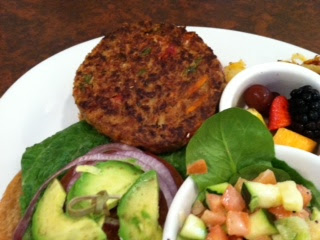
A Healthy Vegan Lunch
Friday, February 24, 2012
Food and Too Much of It

I was really angry at myself last week for enjoying the aromas of the food court at the mall and fascinated by the way I responded to those smells. Is there a physiological or psychological trigger in those smells that ignited my olfactory and gustatory senses? Will I always be affected or influenced by those smells…especially freshly brewed coffee, whose smell I enjoy more than its taste? Or, will years of not eating those foods eventually make me immune to their allure? I began to wonder why we eat, not just why we eat fried or greasy foods, but why we eat and when and how we begin to develop our eating patterns.
Hunger for infants is a strong biological urge. A baby’s cry is a demand to be fed immediately. Infants know when they are hungry and what they need to eat. But as soon as babies are able to eat solid foods, their eating habits and behaviors become conditioned by their caregivers. Our caregivers decide what kinds of foods to feed us, and whether we will receive a healthy portion of broccoli or a hotdog that has been filled with chemicals. Children’s good behavior is rewarded with sugary sweets, ice cream and candy. We become conditioned to eating in certain ways and under a variety of circumstances. As a child I was told to “clean my plate.” After all, there were children starving in Africa who weren’t as fortunate as I was. We learned to eat to please other people. I usually eat three times a day. Is that a result of conditioning? I usually know when I am hungry; I sense a physical cue, whether it’s a growl or a pang in my stomach, and all I need to do is to find something that I find suitable to eat.
However, we eat for many reasons other than hunger. We eat socially, because that is what is expected of us in that situation. We eat when the opportunity presents itself, whether it is because we are passing through a food court or passing by a bakery, watching a movie or sitting at a ball game. We eat because the clock tells us that it is time to eat. We eat because it’s there. We eat to comfort ourselves. Sometimes we eat automatically. We see a trigger food and, before we are aware, we have eaten it. We eat as soon as we come home from work. We eat at the computer or in front of the television. We eat until all the food on our plate is gone. Our bodies know when, what and how much to eat to maintain functioning, but we have been conditioned to eat in response to certain stimuli. We forget to listen to what our body is telling us.
As adults we continue to overeat because we have been taught to clean our plates. Restaurants pile on the food, and the average portion size has quadrupled in the last 20 years. And yet, we live at a time when our society is obsessed with weight, body size and shape. We celebrate the July 4th holiday, Memorial Day, Thanksgiving and Christmas where food dominates. As a culture we are confused about the role that food should play in our lives. We use food for more than just satisfying our hunger. We eat when we are tired, anxious, sad, happy, or bored. We eat to celebrate and to mourn.
We are fortunate as a nation to have more food than we can eat. It is true that many people all over the world are starving. In the past there were always periods of feast and famine, and as a species we learned to eat when food was plentiful. That no longer serves us, but we continue to eat more food than we need, and in the United States we no longer worry about famines. The body is designed to survive. Eating lots of food today to prepare for scarcity tomorrow made sense as a survival mode for our ancestors, but it it make no sense today.
Eating need not be reflexive or simply the product of learned habits. We can change those habits. In the 1960s, we announced that “we are what we eat.” That is as true today as it was then. The question is what we choose to be and how that is reflected in the food we consume.
Subscribe to:
Posts (Atom)